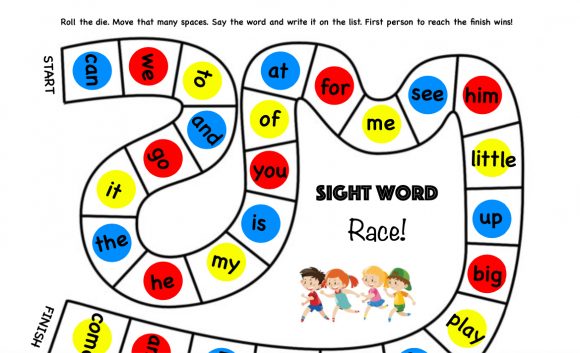
Sight Word Race: Turning Repetition into Playful Literacy Practice
Memorizing high-frequency words often feels like a chore for early readers, but the Sight Word Race transforms this necessary repetition into an engaging, tactile experience. At its core, this activity is a board game where children practice reading and writing as they play. Whether working alone or in partners, children take turns rolling a die and moving the correct number of spaces. The mechanic is simple yet effective: children read the word they land on and then write the word on their provided word list. The first one to the finish line wins, but the real victory lies in the multisensory reinforcement of literacy skills.
For parents, tutors, and educators aged 20 to 50 who are navigating the complexities of early childhood education, this game offers a practical solution to the "flashcard fatigue" that often plagues reading instruction. It bridges the gap between passive recognition and active production, requiring students to not only decode text but also encode it through handwriting. This dual-processing approach is particularly valuable in real-world learning environments where engagement is just as important as academic rigor.
Real-World Applications Across Learning Environments
The versatility of the Sight Word Race makes it a staple resource across various educational settings. It is rarely used in isolation; rather, it serves as a strategic tool within broader literacy frameworks. Understanding where and how to deploy this game can maximize its effectiveness for different audiences.
The Homeschool Morning Routine
In homeschooling environments, transitions between subjects can be friction points. The Sight Word Race functions exceptionally well as a bridge activity. For parents managing multiple age groups, this game allows for independent or sibling-paired practice while the parent focuses on direct instruction with another child. Because the rules are intuitive, children can self-regulate the gameplay. A parent might set up the board with the current week’s Dolch or Fry list, allowing the child to warm up their brain and fine motor skills before tackling more complex phonics lessons. The competitive element keeps energy levels high during those mid-morning slumps when attention spans typically wane.
Classroom Literacy Centers and RTI
For classroom teachers, this game is a workhorse for differentiated instruction during center rotations. In a Response to Intervention (RTI) model, small groups often need targeted practice without constant teacher supervision. The Sight Word Race provides structured accountability. Teachers can customize boards for specific intervention groups; one board might focus on CVC words for emerging readers, while another targets multi-syllabic sight words for advanced learners. The written component serves as built-in formative assessment. By collecting the word lists at the end of the session, educators gain immediate data on which words students are reading correctly but struggling to spell, informing future mini-lessons.
Therapeutic and Special Education Contexts
Occupational therapists and special education professionals appreciate the game’s integration of visual-motor skills. Writing a word immediately after reading it reinforces neural pathways connecting language processing with hand-eye coordination. For students with dyslexia or ADHD, the gamified structure reduces the anxiety often associated with rote memorization. The physical act of rolling the die and moving a token provides sensory feedback that helps anchor memory. In these settings, the "race" aspect can be modified to be collaborative rather than competitive, focusing on collective progress toward the finish line to support social-emotional learning alongside literacy goals.
Adapting the Game for Diverse Learner Needs
One size rarely fits all in literacy instruction. While the standard Sight Word Race format is effective, its true power emerges when adults adapt it to fit specific learner profiles and logistical constraints.
- For Pre-Writers or Students with Dysgraphia: Modify the output requirement. Instead of writing the full word, children can trace dotted versions, stamp the word using letter stamps, or build it with magnetic letters. This maintains the orthographic mapping process without causing physical frustration.
- For Advanced Readers: Increase cognitive load by requiring students to use the landed word in a complete sentence on their recording sheet. Alternatively, require them to write a synonym or antonym instead of the word itself, deepening vocabulary comprehension.
- For English Language Learners (ELLs): Pair the sight word with a visual icon on the board. Require students to say the word aloud to a partner before writing it, emphasizing oral language production and peer verification.
- For Solo Practice: Transform the race into a personal best challenge. Use a timer or a tally system where the student races against their previous score rather than another person, fostering intrinsic motivation and self-monitoring.
Practical Considerations Before Implementation
Before printing boards and grabbing dice, there are several logistical and pedagogical factors to consider to ensure the Sight Word Race supports genuine learning rather than just busy work.
Word Selection Matters Most
Avoid populating the board with random high-frequency words. Select terms based on recent explicit instruction or specific error patterns observed in student writing. If a child has never been taught the irregular spelling of "said," landing on it repeatedly during a race will only reinforce confusion. The game should be a rehearsal space for known or partially known concepts, not a guessing game.
Monitoring Accuracy Over Speed
The competitive nature of racing can incentivize speed over accuracy. Young learners may rush through reading or scribble illegibly to reach the finish line first. Establish clear ground rules: a move only counts if the word is read correctly and written legibly. Partners or teachers should act as validators. Consider adding a "checkpoint" rule where players must pause every five spaces to review their list together, slowing the pace and reinforcing quality.
Durability and Reusability
In high-use environments like classrooms or tutoring centers, paper boards deteriorate quickly. Investing time in laminating boards or placing them in dry-erase sleeves extends their lifespan significantly. Dry-erase sleeves also allow students to write directly on the board if recording sheets are lost or if you want to reduce paper waste. Having multiple color-coded sets organized by reading level prevents setup delays and keeps instructional momentum flowing.
Strengths and Limitations to Keep in Mind
While highly effective, the Sight Word Race is not a standalone curriculum. Recognizing its boundaries helps adults use it more strategically.
The primary strength is engagement through repetition. Traditional drill methods often lead to disengagement, whereas this game leverages play psychology to sustain attention. The combination of gross motor movement (moving pieces), fine motor output (writing), and cognitive processing (reading) creates a rich learning episode that static worksheets cannot replicate. It also builds social skills like turn-taking, graceful winning/losing, and peer teaching when played in pairs.
However, limitations exist. The game does not teach decoding strategies; it reinforces automaticity. Relying solely on this activity for reading instruction neglects phonemic awareness and phonics. Additionally, the writing component can become a bottleneck for students with significant fine motor delays, potentially turning a fun game into a source of stress. Adults must remain observant and ready to scaffold or modify. Finally, without proper oversight, students may reinforce misreadings. If a child consistently misreads "were" as "where" and writes it incorrectly ten times during a game, unlearning that error becomes harder. Active supervision or structured peer-checking protocols are non-negotiable for maximizing benefit.
Ultimately, the Sight Word Race succeeds because it respects the child’s desire to play while honoring the adult’s need for meaningful practice. It turns the abstract challenge of literacy acquisition into a concrete, manageable, and enjoyable journey toward the finish line.